
Entre los días 27 y 29 de marzo de 2025 se ha celebrado virtualmente (on line) el 2º Congreso sobre Geoconservación del Grupo de Trabajo Regional del Suroeste de Europa de ProGEO (ProGEO SW Europe Regional Working Group Virtual Conference on Geoconservation, 2nd Edition).
En él se han presentado decenas de comunicaciones sobre patrimonio geológico y geoconservación llevadas a cabo por los grupos de investigación y gestores patrimoniales del suroeste de Europa, fundamentalmente Italia, España, Portugal y Francia, entre otros países.
Y, como ha venido ocurriendo desde hace más de 30 años, no ha faltado alguna contribución sobre patrimonio geológico y geoconservación en Segovia; concretamente una comunicación sobre los beneficios del patrimonio geológico urbano de Segovia en el geoturismo, la educación y la identidad de las ciudades; aspectos en los que la ciudad y provincia de Segovia son pioneras (desde los años 80s) y siempre han estado en la vanguardia y la innovación.
El abstract en inglés publicado en el libro de actas (apenas una página) contiene un resumen de los aspectos generales sobre esta temática:
Benefits of urban geoheritage for geotourism, education, and identity in cities
Most cities and municipalities have geoheritage within their urban and neighborhood areas as a new resource to offer another form of tourism. Geological resources may be located in public spaces, parks and gardens, and private spaces inside courtyards and homes. Urban geotourism has five basic features that make it a promising new niche tourism:
i) It diversifies the offer of tourism in cities with new and surprising elements,
and unexpected experiences; ii) It supplements the traditional offer, maximizing its appeal and increasing the length of time in overnight stays.
iii) It is there all year round, prolonging the traditional offer in certain seasonal periods (winter in the interior) and at certain times of day (dawn, midday and dusk).
iv) It is an alternative in the absence of historical and artistic resources in new neighborhoods and surrounding zones, distributing tourism and any resources generated more widely.
v) It is accessible and universal to everyone, as most of the heritage outcrops are in public places in the open air. Therefore, their visit and enjoyment do not represent a cost; they are free to access and in equal conditions for all potential visitors.
In addition, urban areas are natural laboratories for formal and informal education. The benefits and values of urban geoheritage are significant for the citizens themselves:
▪ The city’s geology signifies its identity as iconic landscapes and unique rock landforms.
▪ Urban geology is linked to knowledge of the planet: a fantastic Earth history.
▪ Confluence with other heritage types (historical, religious, traditional trades, legends, etc. with a geological background).
▪ Raising awareness of the major environmental crises and challenges facing society.
▪ An opportunity for holistic nature conservation.
▪ Increasing the well-being and health of millions of citizens living in urban environments.
The fact that this geoheritage is located in public spaces also guarantees greater accessibility for people with disabilities, as opposed to the geoheritage in protected natural spaces or in rural areas that are much more difficult to access, where many of the routes are not accessible to these people. However, this heritage in urban settings is more fragile and vulnerable as it is subjected to greater pressure and impact. Pollution, civil works, urbanization, and, in short, the occupation and management of public spaces, demand the promotion of best practice guidelines to guarantee their conservation and the legacy of the future.
Para saber más…
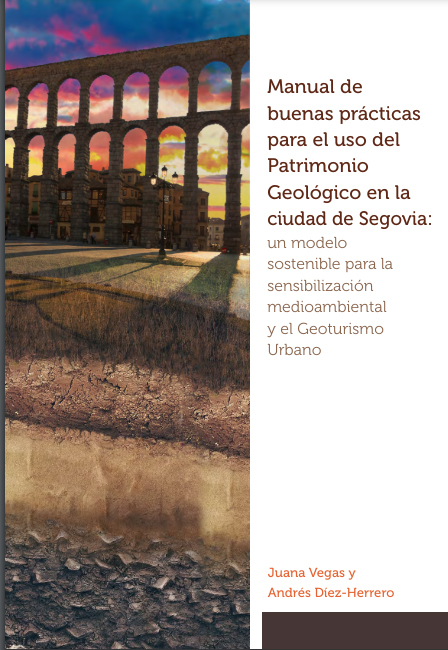
Vegas, J., Díez-Herrero, A. (2018). Best practice guidelines for the use of the geoheritage in the city of Segovia. A sustainable model for environmental awareness and urban geotourism. Ed: Ayuntamiento de Segovia. 59 pp. In:
https://segovia.es/sites/default/files/Components/File_list/Files/Best_practice_guidelines_Geoheritage_in_Segovia.pdf
Vegas J. and Díez-Herrero A. (2025). Benefits of urban geoheritage for geotourism, education, and identity in cities. In: Bollati, I.M., Brustia, E., Melelli, L., Monge-Ganuzas, M., Pica, A., Pompili, R., Rodrigues, J., Rouget, I. (Eds.), ProGEO SW Europe Regional Working Group Virtual Conference on Geoconservation (2nd Edition), Abstracts Book, p. 71, 27-29 March, 125 pp.